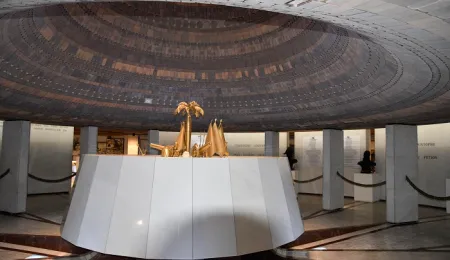
In the heart of downtown Port-au-Prince, on the edge of Champs de Mars, lies one of Haiti’s most important cultural landmarks: the Museum of the Haitian National Pantheon (MUPANAH). Built partially underground, the museum safeguards centuries of Haitian history — from the island’s Indigenous roots to its revolutionary triumphs and beyond. For anyone looking to truly understand Haiti, a visit here is essential.
Opened in 1983, MUPANAH was created to honor the lives and legacies of Haiti’s founding fathers — including Toussaint Louverture, Jean-Jacques Dessalines, Alexandre Pétion, and Henri Christophe. The museum itself is as resilient as the stories it preserves. Thanks to its underground design, it survived the devastating 2010 earthquake with little damage, remaining a guardian of Haitian memory at a time when so much was lost.
Inside, visitors are guided through Haiti’s journey. The permanent exhibit traces the story from the Taíno people who first inhabited the island, through colonization and slavery, to the revolution that gave birth to the world’s first free Black republic. The displays are striking: shackles and torture instruments once used to control enslaved Africans; the massive 13-foot anchor from Christopher Columbus’s Santa Maria; and the silver pistol that King Henri Christophe used to end his life. Sobering as these artifacts may be, they make history tangible in ways words alone cannot.
Among the most powerful items on display is the Independence Bell, rung in 1804 to announce Haiti’s freedom. Standing before it is a reminder that Haiti’s story is one not only of suffering, but of resilience, defiance, and victory. Alongside these treasures, rotating temporary exhibits bring fresh perspectives, showcasing Haitian artists whose work reflects themes of identity, culture, and current events.
The museum experience doesn’t end indoors. Outside, the MUPANAH Gardens provide a refreshing contrast to the weight of history. Bright and open, the gardens feature sculptures, tropical greenery, and airy spaces to sit and reflect. They’re also home to a restaurant known for some of the city’s best French cuisine, and they serve as a venue for cultural events, including the International Jazz Festival of Port-au-Prince.
For travelers, MUPANAH offers a rare opportunity to see both the physical artifacts of Haiti’s past and the living culture of its present. Tours are available in Creole, French, and English, making the history accessible to visitors from around the world. The museum is open daily, including holidays, making it easy to include in a trip to Port-au-Prince.
If you want to go beyond the surface of Haiti and connect with its soul, start here. The Museum of the Haitian National Pantheon is more than a collection of artifacts — it’s the beating heart of Haiti’s history, resilience, and pride.